As with most restaurants worth visiting in Venice, you could quite easily walk past Zanze without being immediately drawn in. Had we not stumbled upon a picture of one of their dishes on Instagram, we likely would never have discovered it. Hidden in plain sight on the more gently travelled right-hand side of the entrance to Venice and still having weekends booked out months in advance means serious business.
On their website, Zanze XVI describe themselves as ‘an osteria’. In Italy, the difference between ‘Osteria’, ‘Trattoria’ and ‘Ristorante’ are mainly historical, but bear some relevance still today. Ristoranti is where you can expect to pay the most; there’s a host, a team of waiters and a sommelier. There’s also definitely a cover charge. Trattorie are the more basic, red-and-white checkered tablecloth dining venues – known for Italian homecooking classics. Osterie, however, are typically bars that offer a small, daily menu at a fixed price — the very opposite of our experience at Zanze.
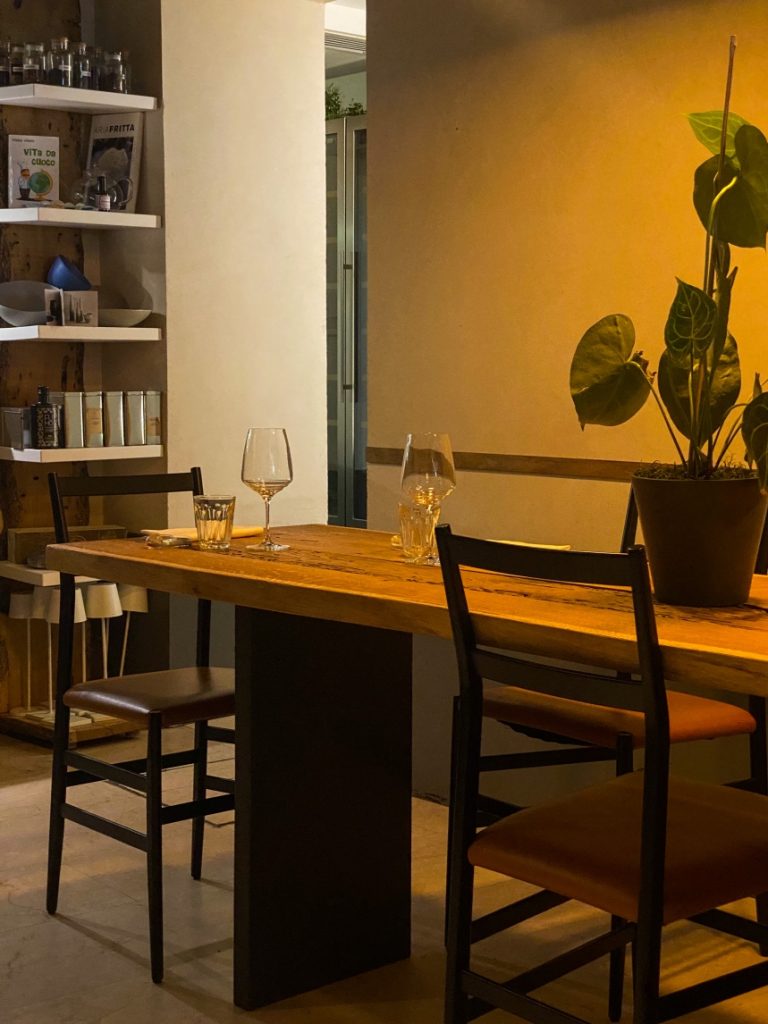
The venue is small, dimly lit and top-to-bottom contemporary, with Nordic-angled furniture, monstera plants and a cool beige-grey-black palette. The servers are dressed smartly with pressed light grey dress shirts and dark suit pants. Amidst the low buzz of chatter between diners, there is a light touch of ambient music.
We’re welcomed swiftly to our small table against the wall and offered refreshments. Usually when we eat out, we don’t bother ordering any water and settle for our glasses (or bottle) of wine. This time, we have seven courses ahead of us with a glass of wine for each, and so the water might be a welcome aid – even if just as a palate cleanser.
“Regarde – nos verres,” (Look, it’s our glasses) my date says. And indeed – it’s the Zafferano Esperienze wine glasses we’ve been eyeing ever since we first saw them in Alba last year. We fiddle with the ribbed base a little, making yet another mental note to buy them as we wait for our first course to be served.
And then it is.
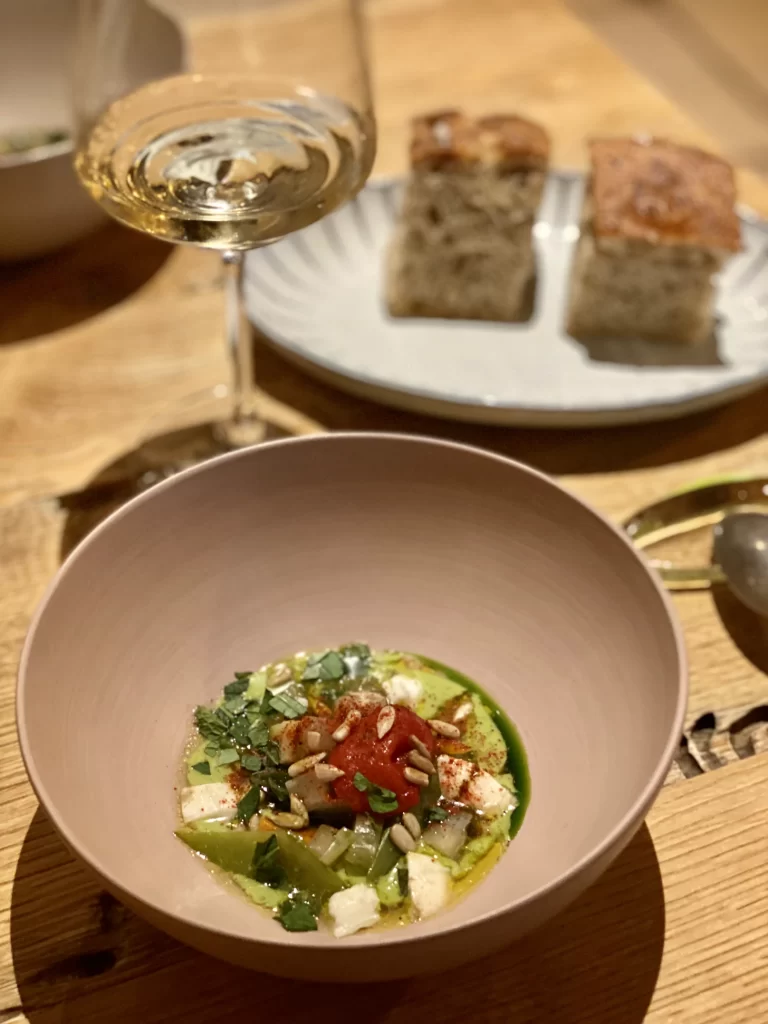
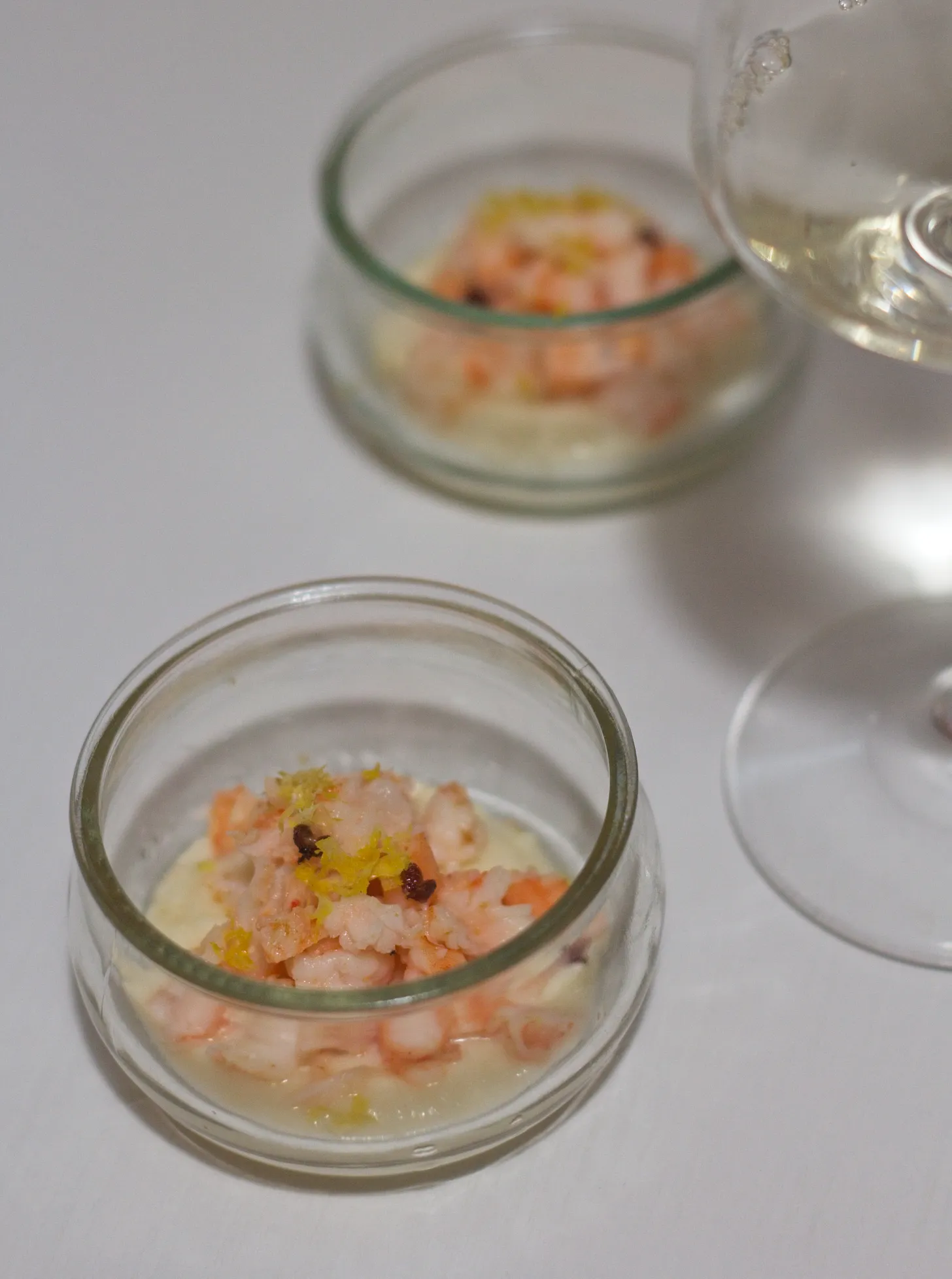
To start: Warm Minestrone, served with Prosecco – Loredan Gasparini’s Asolo Supérieure from Veneto, to be exact.
This dish was interesting, with many different textures and little bursts of flavour.
From the outset here, it is already clear to see the influence of the orient on the cuisine – a theme which would continue throughout the five courses. Alongside, one of the most incredible breads I’ve ever tasted in my entire life: spongey, yet thick with olive oil and spiced to perfection. We tore it into the tiniest pieces when eating, trying to make it last. While the Prosecco added nothing particularly special to the taste profile, it was a refreshing start to the experience with its bright, acidic apple palate.
Between each plate, the wine arrives first. And so we were eased into our next dish with a glass of Garganega (Benavides by Vignale di Cecilia from Veneto) – a varietal that I’ve had a hard time getting into. Again, here, any appreciation of its body is diluted by its strong citrus notes.
Then the plate arrives: laksa, baby octopus and green beans. The fullness of the curry spices, paired with the perfectly tender octopus, creates an equilibrium akin to surf ‘n turf meals.
Then there’s the mixture of textures: crunchy beans, crispy octopus skin, soft laksa… Even on its own, this dish was a solid 8.
What pushed it over to an 11 out of 10, however, was the addition of the wine.
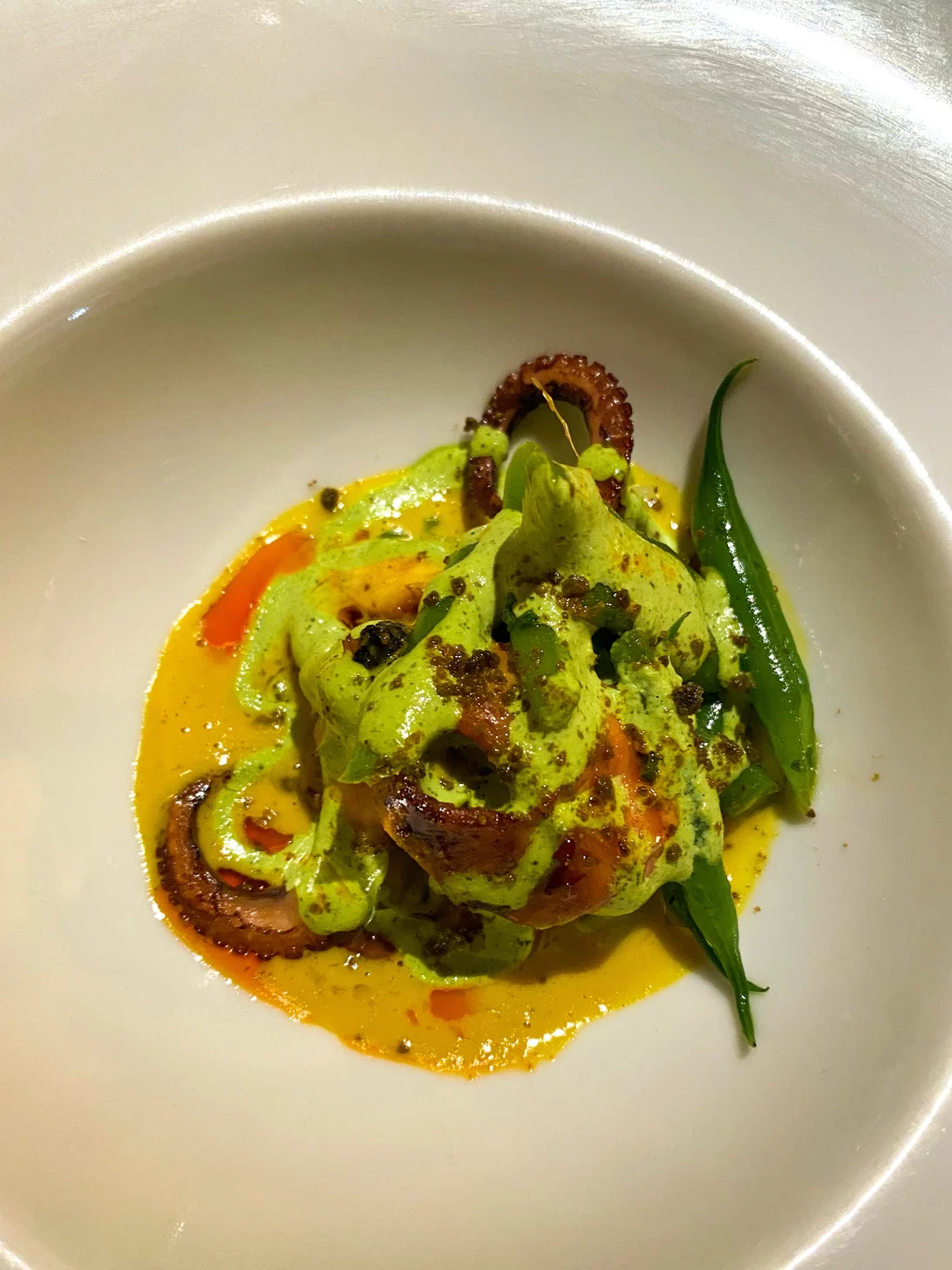
The citrus that I had previously found so disturbing suddenly became its biggest boon, brightening the curry and lengthening its flavour. I’ll be buying a bottle of Garganega every time I make a homemade curry from now on.
Pasta e fagioli (pasta and beans) is a classic Venetian dish that although being a home staple, is not often seen on restaurant menus. At Zanze, however, one cannot expect too much familiarity.
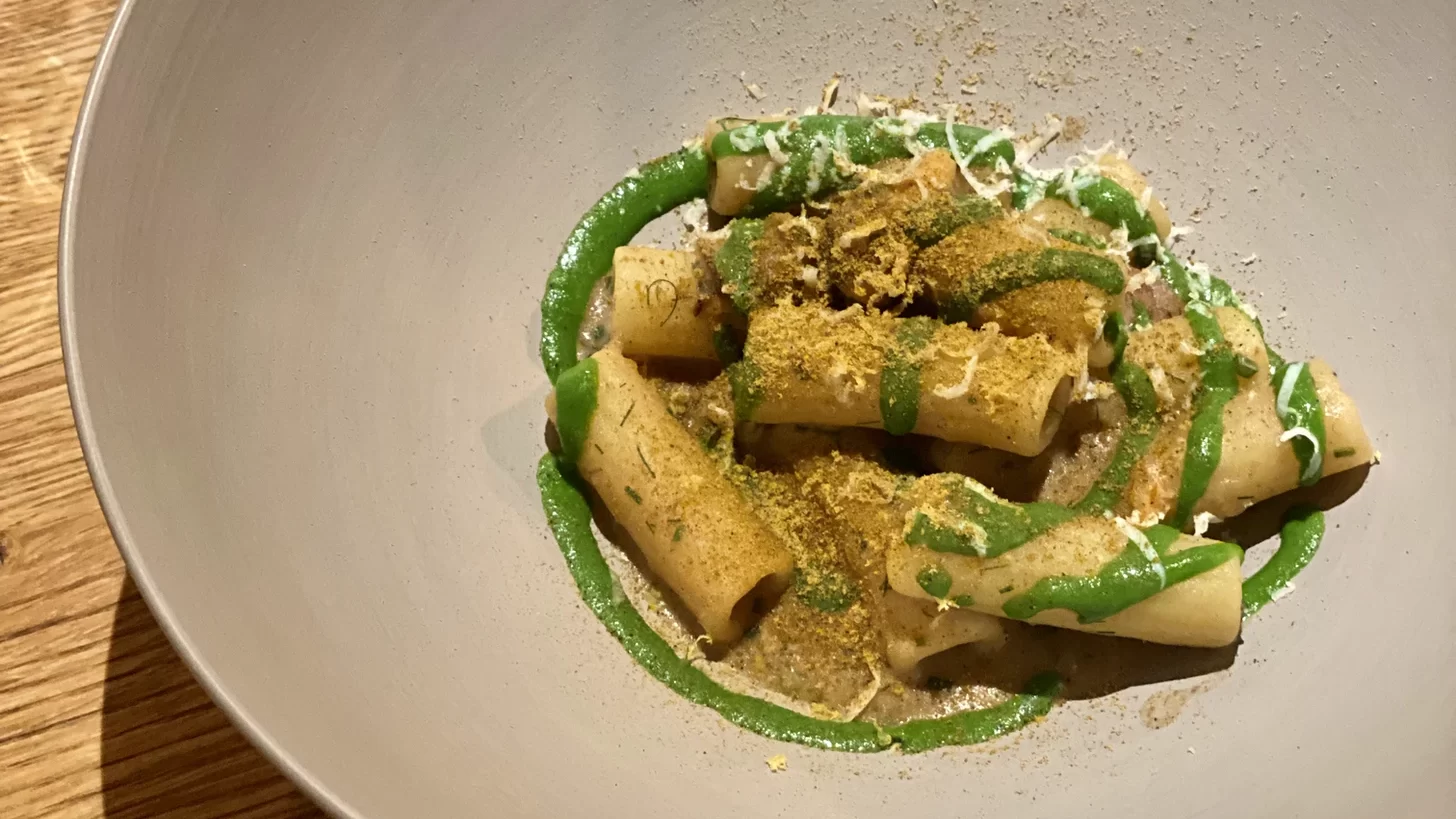
Here, they are served with ‘mussels-bushi’ — another nod to their Asian influence.
Bushi is a Japanese preparation where fish (typically skipjack tuna, as with katsuobushi) is deboned and filleted, boiled and then repeatedly smoked and dried until it becomes hard. How hard? Ask the Guinness World Records.
Here, the mussels-bushi is powdered over the rigatoni, beans and mussels pieces. The Garganega accompanied this dish too – and though it didn’t ‘wow’ as it had with the previous dish, it nonetheless established a good balance.
Next, we are served a glass of Tomassetti Cercanome Verdicchio from Le Marche – a light but fruity and gently acidic wine with notes of pear and caramel.
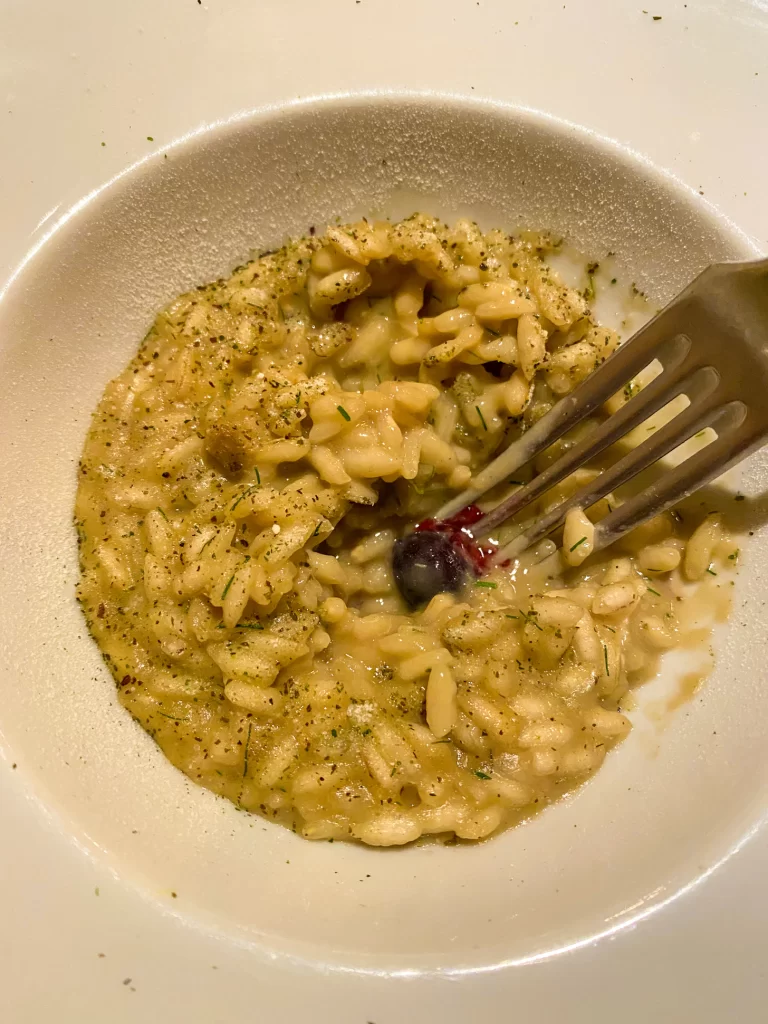
A few moments later, the plate arrives: a risotto of Venetian lagoon goby with yogurt and algae.
My date and I run our fingers along the plate’s edge, trying to identify the powder, and we finally decide on onion and chives (kind of like the green tube of Pringles).
The first forkful from the top is great – warm and comforting as a risotto should be. It looks and tastes unassuming at this point, almost ‘normal’. But this is contemporary dining, and we are not to be fooled. When we press our forks deeper, there’s a sudden burst of colour. Oh yes, the other ingredient: blueberries. Suddenly, the wine and dish are in harmony, with a song that lights up all the senses – it’s another dish that we don’t want to end.
The Verdicchio comes along for the ride in the next dish too. When it arrives and the waitron announces the ingredients, I already know that it’ll be my favourite.
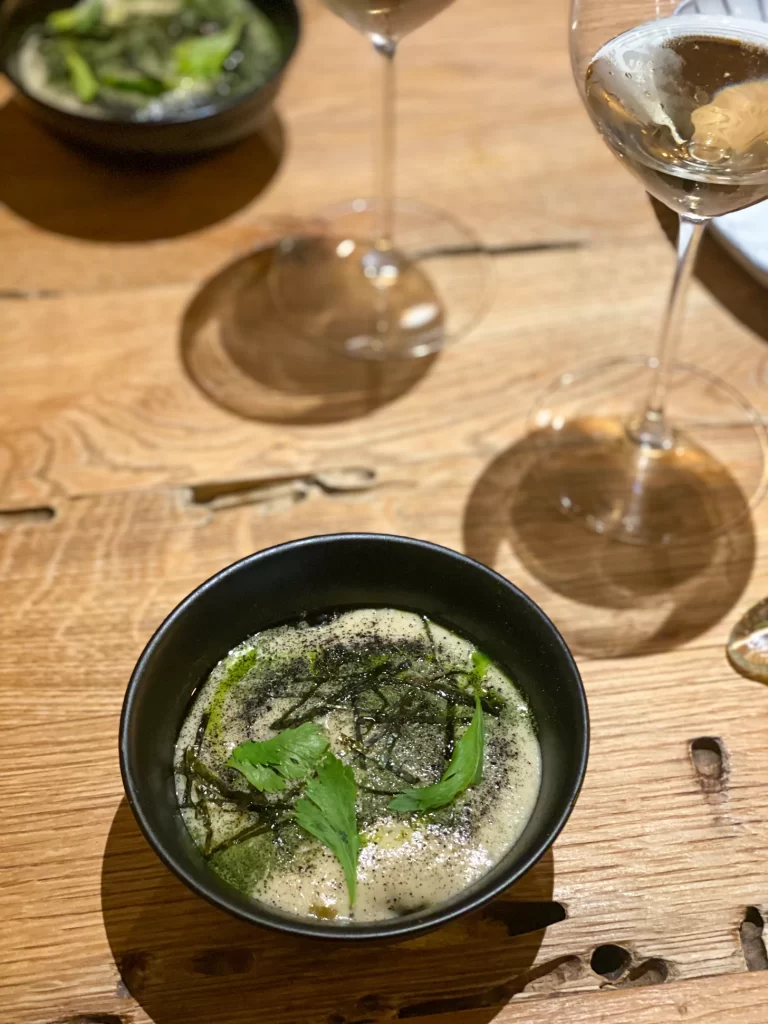
Celery chawanmushi, cuttlefish and kimchi.
Chawanmushi is a type of steamed savoury custard from Japan, while kimchi is fermented cabbage (or radish) from Korea.
Pairing these two preparations with the Venetian staple of cuttlefish (along with its onyx-like ink) made this dish easy on both the eyes, the tongue and stomach.
Some steak is next – sea bass steak, that is: barbecued to perfection and set alongside some brocoli, mole verde and black garlic seasoning.
We’ve departed from the Asiatic influence now, turning towards Central America, where ‘mole’ is known as a type of sauce or marinade made from (in their varieties) a fruit, a nut and a chili pepper. Here, it is made of pumpkin seeds and green chillies. The fish is – as expected by this point, perfectly tender and well seasoned.
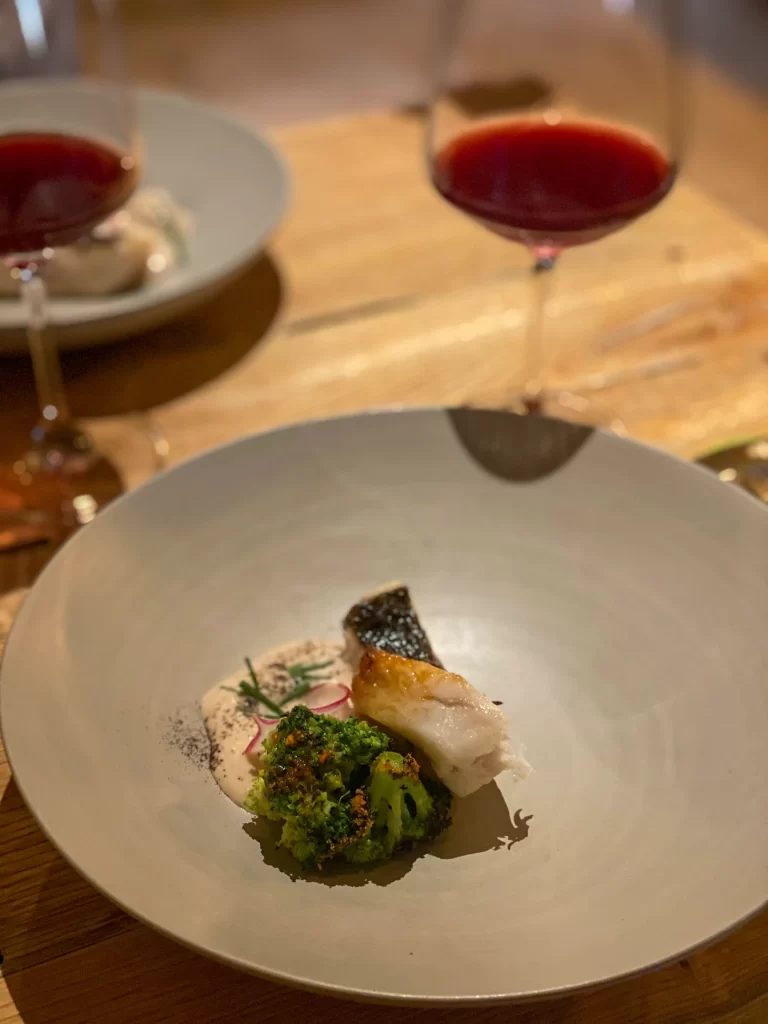
With this, some red wine – 3/4 Rosso by Sa Defenza in Sardegna, which brings an element of tartness to the dish.
And then, finally, the dessert.
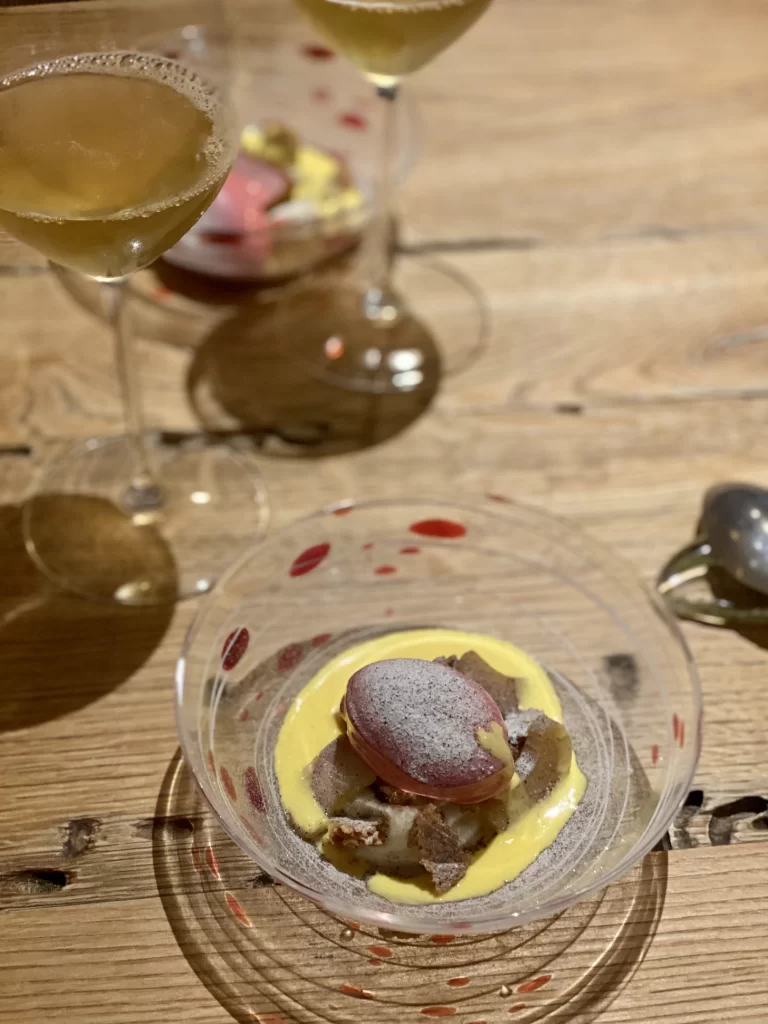
Cinammon biscuit, encircled with a passion fruit cream and topped with a raspberry gelato. In isolation, each of the elements were either too sweet or simply uninteresting.
Altogether, the dessert was good – but maybe a little sweet.
The pairing? Beer, if you can believe it. With this fantastic dessert, we were served an artisanal corn beer and – wait for it – it worked.
The bitterness of the beer took a palate that had hinged on too sweet and brought it back to equilibrium, lengthening its finish and especially brightening the cinnamon notes that had been diluted by the raspberry. Together, they created an incredible balance that demanded gluttony.
As mentioned above, there were several key factors of this dining experience that negated Zanze XVI’s self-description of being an Osteria. One particular element that would have nonetheless been a welcome addition to our meal, is warmth. While many of the dishes were incredibly interesting, and every wine (and beer) a great pairing, the announcement of the dish at the table was brief, to-the-point and empty of any narrative. At a restaurant like Zanze XVI, who already goes to great lengths to create a beautiful ambience and fantastic menu, the absence of this kind of service makes a big impact, scaling the experience down from fully immersive, to merely ‘yum’.
Our summary? A lot of successes, but one big oversight.
Since the publication of this review in July 2021, Zanze XVI has earned itself its very first Michelin star.
Zanze XVI
Santa Croce, 231, 30135 Venezia VE, Italy